
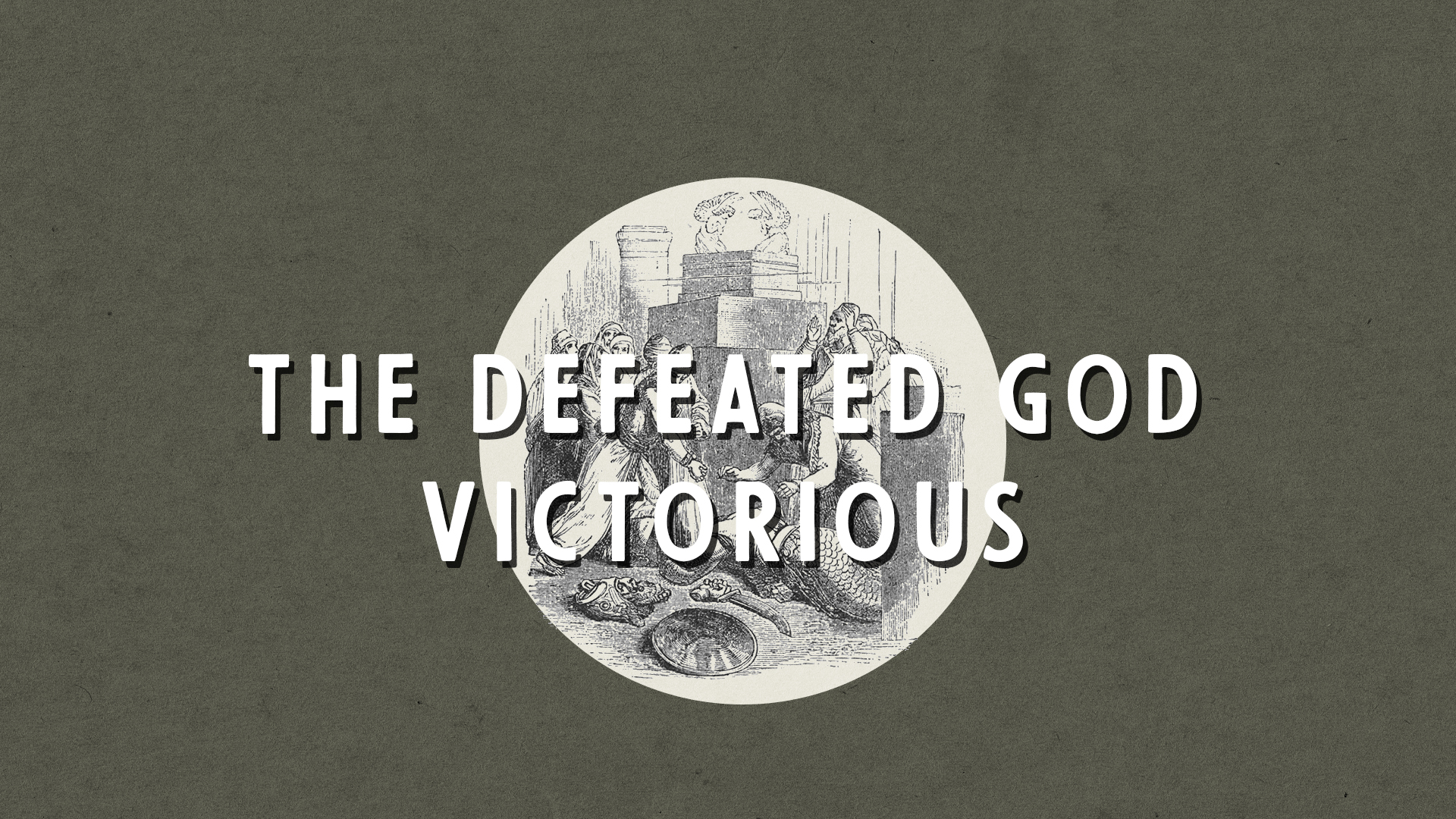
The Defeated God Victorious
I’m not sure that there is a more fascinating or instructive narrative in Scripture in the book of 1 Samuel than that of the account of the defeat of Israel in 1 Samuel 4 and the fall of Dagon before the ark of God in 1 Samuel 5:1-5. It is one of the most wonderful portions of God’s word as it finds it’s fulfillment in the unfolding of redemptive history.
In 1 Samuel 4, Samuel tells us that the Israelites had superstitiously taken the ark of the covenant into battle against the Philistines after losing 4,000 men in battel. Their foolish self-trust led to the defeat of another 30,000 Israelite warriors (1 Samuel 4:1–11). Israel had trusted in their own efforts to gain victory and had turned the typological object of God’s presence among his people into a self-righteous effort to make themselves great. They had summoned Hophni and Phineas, the two rebellious priest-sons of Eli, to bring the ark into the battle. Instead of repenting of the sin that had brought the Philistines to afflict them, God’s people trusted in wicked leaders and a superstitious view of the ark. John Calvin explains the evil of their actions when he wrote,
“Their superstitious faith is exposed, because they imagine God to be bound to this ark. Then their proud arrogance, because they persuade themselves that help is owed to them in their straits, which God had formerly promised them — yet they pay no attention to the condition attached.”
Again, Calvin explained, “they seemed to want to triumph without God, indeed to raise trophies against him, although they bore his name before them, but falsely, and gloried in it.”
Having been squarely defeated by God’s enemies, the ark was taken captive and carried into a pagan land. Dale Ralph Davis explains what the Lord was teaching Israel when He allowed His people to be defeated by the Philistines and the ark captured, when he writes,
“Yahweh will suffer shame rather than allow you to carry on a false relationship with him; and Yahweh will allow you to be disappointed with him if it will awaken you to the sort of God he really is.”
Derek Thomas adds to this, noting, “God would rather suffer defeat than allow us to think that we can own Him.”
This was an unparalleled low point for the covenant people of God in redemptive history. The ark was captured by God’s enemies. As Phineas’ wife declared as she gave birth at the same time that the ark was captured, “The glory had departed.” If there is no ark, there is no tangible presence of God among His people.
The ark was essentially the great type of Christ in the Old Covenant economy. There was no greater symbol of the Lord’s dwelling with His people than the box overlaid with gold in which were the tablets of the covenant, the golden bowl full of manna, and Aaron’s rod that budded. It was covered with a mercy seat, over which two cherubim were facing one another. Whenever the blood of the sacrifice was carried in on the Day of Atonement, the glory of God appeared between the cherubim (Psalm 99:1). The ark was God’s throne, His footstool, and His manifest glory among His people. In the Old Covenant, the people of God came to the tabernacle, and then later to the Temple, to worship the God of Israel who dwelt in the most holy place over the ark of the covenant.
Ultimately, the ark pointed to the Lord Jesus. It is the greatest type of Christ in Israel’s old covenant cultic system. He is one that keeps the law of God in himself. He is that bread that came down from heaven typified by the manna in the wilderness. He is God’s chosen priest as represented by Aaron’s rod that budded. When Jesus rose from the dead, there was an angel, one at his head and an angel at his feet where his body had lain. He is the glory of God (Heb. 1:3; John 1:14; 2 Corinthians 4:6). His resurrection is the outshining of his glory. As Richard Sibbes explained,
“As in the law, when the mercy seat was made, two cherubim were also framed, and placed one at the one end, and the other at the other end thereof, with their faces looking toward one another, Exodus 25:20. And, when Christ was risen, there were two angels, one at the head, another at the feet, to show that peace was to be expected in the true propitiatory, Jesus Christ…Peace was made between heaven and earth.”
Geerhardus Vos also observed,
“The presence of these two angels, silently, reverently, majestically sitting where the body of Jesus had lain. . .placed like the Cherubim on the mercy-seat, they covered between themselves the spot where the Lord had reposed and flooded it with celestial glory.”
We are, therefore, meant to identify the ark with the promised Redeemer, God manifest in the flesh who is himself the glory of God.
When the Philistines captured the ark and put it in the temple of Dagon in Ashdod, they were attempting to subject Yahweh to their pagan god. They have essentially added another deity to their collection of deities. Matthew Henry noted,
“They placed it there as a trophy of victory, in honor of Dagon their god, to whom no doubt they intended to offer a great sacrifice, as they had done when they had taken Samson (Jdg. 16:23, 24), boasting that as then they had triumphed over Israel’s champion so now over Israel’s God.”
In the mind of the Philistines, their god, Dagon, had defeated the God of Israel. But then the ironic twist in the account. Samuel writes that “when the people of Ashdod rose early the next day, behold, Dagon had fallen face downward on the ground before the ark of the Lord.” The Philistines pick up their impotent and fallen god and set him back up in his place. The next morning they came into the temple and find that Dagon has fallen again. This time, Dagon’s head and hands are broken off from his body. Yahweh has utterly destroyed the false god, Dagon.
1 Samuel 5 reveals a rich biblical-theological note in redemptive history. In the conflict between Dagon and Yahweh, there is an unfolding of the first promise of redemption in Genesis 3:15. Here the seed of the woman is conquering the seed of the serpent. Behind the pagan gods of the Philistines, were the demons which had been behind the pagan gods of the Egyptians (Deuteronomy 32:16–17). Behind all worthless and non-existent idols are demons (1 Cor. 10:19–21). In the temple of Dagon, the living God conquers the demon gods of the Philistines. Though he seems defeated, he is actually in the place of defeating this demon-god. As Dale Ralph Davis explains,
“Dagon is simply getting the godness knocked out of him. Indeed, the Philistines themselves will soon admit that Yahweh has “out-godded” their god (v. 7). So the “defeated” God defeats the “victorious” god on the latter’s home turf. . .Yahweh doesn’t have to have someone come and set him up again. He can fight the Philistines by himself. He doesn’t need his people to cheer him on; he will bring back his ark all by himself. Humor, yes; but didactic humor, teaching the self-sufficiency and supremacy of Yahweh.”
As we trace the unfolding of redemptive history, we find the victory fulfilled in Jesus’ death on the cross and resurrection. In his death on the cross, Christ “disarmed the rulers and authorities and put them to open shame, by triumphing over them” (Col. 2:15). Though he seemed defeated by the powers of darkness, Jesus conquers the kingdom of darkness by his death. “The ‘defeated’ God defeats the ‘victorious’ god of this world.” In his death, Jesus crushes the head of the true Dagon, Satan himself. Jonathan Edwards tied Dagon falling in the morning before Yahweh to the victory of Christ in his resurrection early in the morning, when he wrote, “Dagon fell, once and again, before the ark early in the morning [1 Sam. 5:4]. . .So Christ rose from the dead early in the morning.”
1 Samuel 5:1–5 teaches us that all the gods of the nations are worthless idols and that Yahweh alone is to be worshiped and served. Edwards again insisted, “God honored Christ as above the heathen gods in causing the image of Dagon to fall before him, and breaking off his head and hands [1 Sam. 5].” When the Apostle Paul brings the exaltation of the risen and reigning Christ into focus, he says, “God has highly exalted him and bestowed on him the name that is above every name, so that at the name of Jesus every knee should bow, in heaven and on earth and under the earth, and every tongue confess that Jesus Christ is Lord, to the glory of God the Father (Phil. 2:9–11). In Christ, the defeated God is the victorious God.


About Post Author
